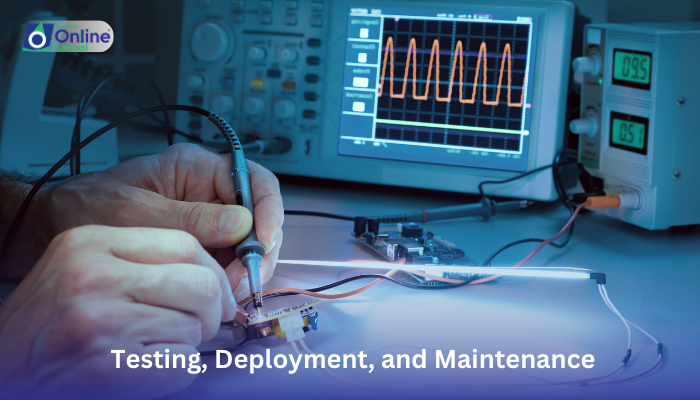
Lesson 10: Testing, Deployment, and Maintenance

Lesson 21/93 | Study Time: 30 Min
Lesson 10: Testing, Deployment, and Maintenance

Learning Outcomes:


i. Understand the significance of testing, deployment, and maintenance phases in the System Development Life Cycle (SDLC).


ii. Explore different testing techniques used to ensure system quality and functionality.


iii. Appreciate the importance of a smooth and successful system deployment.


iv. Recognize the ongoing role of maintenance and support in keeping systems up-to-date and operational.


Introduction:


Imagine composing a magnificent symphony – you wouldn't perform it live without endless rehearsals and fine-tuning, would you? Similarly, the final stages of the SDLC - testing, deployment, and maintenance - are where the system is meticulously tested, launched into the real world, and continuously cared for, ensuring it delivers its intended melody long after the initial creation.


i. The Orchestra Rehearses – Exploring Testing:


Think of testing as the symphony's rehearsal. It's about rigorously scrutinizing the system to identify errors, bugs, and performance issues before it reaches the audience. This critical phase involves:


Unit Testing: Testing individual code modules in isolation to isolate and fix any errors early on.


Integration Testing: Checking how different modules interact and communicate with each other, ensuring seamless integration.


System Testing: Evaluating the entire system against its original requirements and user expectations, identifying any discrepancies.


Acceptance Testing: Letting users and stakeholders test the system to ensure it meets their needs and expectations before final deployment.


ii. Taking the Stage – The Moment of Deployment:


Deployment is like the concert night – the moment the system goes live and interacts with the real world. This crucial phase involves:


Choosing the Right Environment: Selecting the appropriate hardware, software, and network infrastructure to support the system's operation.


Data Migration: Transferring existing data from old systems to the new system seamlessly and securely.


Training and Support: Providing users and system administrators with adequate training and support to ensure smooth adoption and usage.


Monitoring and Performance Optimization: Continuously monitoring the system's performance, identifying bottlenecks, and making adjustments to optimize efficiency.


iii. Maintaining the Melody – The Importance of Ongoing Care:


Just like a symphony needs an orchestra to rehearse and maintain its quality, systems require ongoing maintenance. This crucial phase involves:


Bug Fixes and Updates: Addressing any issues or bugs that arise after deployment, releasing updates to maintain system stability and security.


Adapting to Change: Modifying the system to accommodate new requirements, evolving technologies, and changing user needs.


Performance Optimization: Continuously monitoring and optimizing the system to ensure it remains efficient and responsive over time.


Security and Backups: Regular security audits, implementing strong security measures, and maintaining proper backups to protect against vulnerabilities and data loss.


Testing, deployment, and maintenance are not just final steps; they're the essential chords that keep the system's symphony playing in perfect harmony. By investing time and attention in these crucial phases, you ensure the system not only launches smoothly but also thrives in the real world, delivering value and meeting user needs for years to come. Remember, the next time you effortlessly access a reliable online service or seamlessly use a robust software application, acknowledge the invisible musicians backstage – the testers, deployers, and maintenance experts who fine-tune the system and keep the melody flowing, delivering a continuous performance that enriches our digital lives.



Saboor Ali

Saboor Ali

Product Designer

Class Sessions

1- Lesson 01: Introduction to Operating Systems 2- Lesson 02: Commonly-Used Operating Systems 3- Lesson 03: Types of Operating Systems (1-4) 4- Lesson 04: Types of Operating Systems (5-8) 5- Lesson 05: Embedded Operating Systems 6- Lesson 06: Single-User and Multi-User Operating Systems 7- Lesson 07: Main Functions of Operating System (1-4) 8- Lesson 08: Main Functions of Operating System (5-8) 9- Lesson 09: Understanding Processes 10- Lesson 10: Thread vs. Process 11- Lesson 11: Multi-Threading, Multi-Tasking, and Multi-Programming 12- Lesson 01: Introduction to Systems 13- Lesson 02: Overview of System Development Life Cycle (SDLC) 14- Lesson 03: Objectives of SDLC 15- Lesson 04: Stakeholders and Their Role in SDLC 16- Lesson 05: Planning in SDLC 17- Lesson 06: Feasibility Study 18- Lesson 07: Analysis and Requirement Engineering 19- Lesson 08: Design Phase 20- Lesson 09: Coding and Implementation 21- Lesson 10: Testing, Deployment, and Maintenance 22- Lesson 11: Management in SDLC 23- Lesson 12: Project Manager's Role 24- Lesson 13: System Analyst's Role 25- Lesson 14: Programmer's Contribution 26- Lesson 15: Software Tester's Role 27- Lesson 16: Customer Engagement 28- Lesson 01: Introduction to Programming 29- Lesson 02: C++ Program Structure 30- Lesson 03: Statement Terminator and Comments 31- Lesson 04: Constants and Variables 32- Lesson 05: Variable Naming Rules 33- Lesson 06: C++ Data Types 34- Lesson 07: Constant Qualifier - const 35- Lesson 08: Declaring and Initializing Variables 36- Lesson 09: Type Casting in C++ 37- Lesson 10: Displaying Output with cout Statement 38- Lesson 11: Input with cin Statement 39- Lesson 12: Functions getch( ), gets( ), and puts( ) 40- Lesson 13: Escape Sequences in C++ 41- Lesson 14: Input/Output Handling Functions 42- Lesson 15: Using Manipulators endl and setw 43- Lesson 16: Operators in C++ 44- Lesson 17: Identifying Unary, Binary, and Ternary Operators 45- Lesson 18: Defining an Expression 46- Lesson 19: Order of Precedence of Operators 47- Lesson 20: Compound Expressions 48- Lesson 21: Defining Compound Statements 49- Lesson 01: Decision Statements 50- Lesson 02: Looping Structures 51- Lesson 01: Introduction to Arrays 52- Lesson 02: Array Terminology 53- Lesson 03: Defining and Initializing Arrays 54- Lesson 04: Accessing and Writing in Arrays 55- Lesson 05: Array Traversal with Loops 56- Lesson 06: Using the size of() Function 57- Lesson 07: Introduction to Two-Dimensional Arrays 58- Lesson 08: Working with Two-Dimensional Arrays 59- Lesson 09: Accessing and Writing in Two-Dimensional Arrays 60- Lesson 10: Understanding Strings 61- Lesson 11: String Initialization Techniques 62- Lesson 12: Commonly Used String Functions 63- Lesson 01: Introduction to Functions 64- Lesson 02: Advantages of Using Functions 65- Lesson 03: Function Signature and Terminology 66- Lesson 04: Variables in Functions 67- Lesson 05: Parameters in Functions 68- Lesson 06: Local and Global Functions 69- Lesson 07: Inline Functions 70- Lesson 08: Passing Arguments 71- Lesson 09: Default Arguments and Return Statements 72- Lesson 10: Function Overloading Basics 73- Lesson 11: Advantages of Function Overloading 74- Lesson 12: Function Overloading with Different Arguments 75- Lesson 01: Introduction to Pointers 76- Lesson 02: Memory Addresses and Pointers 77- Lesson 03: Reference Operator (&) 78- Lesson 04: Dereference Operator (*) 79- Lesson 05: Declaration of Pointer Variables 80- Lesson 06: Initializing Pointers 81- Lesson 01: Introduction to Classes and Objects 82- Lesson 02: Members of a Class 83- Lesson 03: Access Specifiers and Data Hiding 84- Lesson 04: Constructors and Destructors 85- Lesson 05: Declaring Objects and Accessing Members 86- Lesson 06: Understanding Inheritance with Examples 87- Lesson 07: Exploring Polymorphism with Examples 88- Lesson 01: Introduction to File Handling 89- Lesson 02: Opening Files with Different Modes 90- Lesson 03: Understanding BOF and EOF 91- Lesson 04: Defining Streams 92- Lesson 05: Using Single Character Streams 93- Lesson 06: Using String Streams